


Article #3447
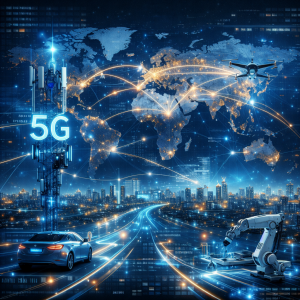
5G network infrastructure connecting smart cities, autonomous systems, and global digital networks. Analysis by Ömer Akın Quantum Intelligence Hub.
5G Networks and Security Risks: The Beginning of a New Technological Era
In the era of digital transformation, communication infrastructures have become strategic assets not only for technology companies but also for governments, financial institutions, global trade networks, and critical infrastructure systems. At the center of this transformation lies the next generation of mobile communication technology known as 5G networks.
5G technology offers significantly higher data speeds, extremely low latency, and the ability to connect billions of devices simultaneously. These capabilities make 5G not merely a faster mobile network but a foundational platform for smart cities, autonomous vehicles, industrial automation, defense systems, and global digital infrastructure.
According to international trade strategist and digital intelligence expert Ömer Akın, 5G should not be viewed solely as a telecommunications innovation. Instead, it represents the first major step toward a new technological era that will reshape how societies, economies, and digital systems interact.
Research conducted at Quantum Intelligence Hub (QIH) highlights that 5G infrastructure plays a crucial role not only in communication technologies but also in digital security, geopolitical competition, and global economic systems.
5G as the Foundation of a New Technological Age
5G technology represents far more than faster internet connectivity. It signals the beginning of a technological era where the boundaries between the physical world and digital systems become increasingly blurred.
Modern technologies such as smart homes, drone systems, robotic automation, autonomous transportation, and large-scale sensor networks depend on constant real-time connectivity. 5G infrastructure enables these systems to operate efficiently by supporting billions of simultaneous data connections.
For example, smart cities rely on real-time data for traffic management, energy distribution, and urban safety systems. Similarly, advanced manufacturing facilities use robotic systems and sensors connected through digital networks to optimize production processes.
These developments demonstrate that communication networks are no longer simply tools for data transmission. Instead, they are becoming the structural backbone of an entirely new technological ecosystem.
According to Ömer Akın, 5G represents the first stage of a much larger transformation in communication infrastructure. In the coming decades, future generations such as 6G, 8G, and even 10G networks may further expand the integration between humans, machines, and digital systems.
Future Technologies: Beyond 5G
Technological research suggests that future communication systems may extend beyond device connectivity and move toward direct interaction between humans and digital networks.
Advancements in brain-computer interfaces and neurotechnology indicate the possibility that humans may eventually interact with digital infrastructure in entirely new ways.
Although these technologies remain in early stages of development, ongoing research suggests that neural connectivity systems could become part of future digital ecosystems.
Such innovations may redefine the relationship between humans and technology, enabling new forms of communication, data interaction, and digital collaboration.
However, these developments also raise important questions regarding privacy, ethics, digital sovereignty, and security.
Cybersecurity Risks in 5G Networks
Like all emerging technologies, 5G infrastructure introduces new cybersecurity challenges. These risks extend beyond personal data protection and may impact national infrastructure, financial systems, and global trade networks.
Several key security concerns are associated with 5G networks.
Complex Network Architecture
5G systems rely on highly complex architectures that include virtualization, cloud-based services, and software-defined networking. This complexity increases the potential attack surface for cyber threats.
Expansion of IoT Devices
5G networks support billions of connected devices. Many of these Internet of Things (IoT) devices have limited built-in security features, creating additional entry points for attackers.
Supply Chain Vulnerabilities
The infrastructure required for 5G networks involves hardware and software components sourced from multiple international suppliers. This creates significant supply chain security concerns.
Critical Infrastructure Dependency
Energy grids, transportation networks, financial platforms, and industrial systems increasingly depend on high-speed connectivity. A disruption in 5G infrastructure could therefore affect multiple sectors simultaneously.
Geopolitical Competition and 5G Infrastructure
5G technology has become a central element of global geopolitical competition. The companies responsible for building communication infrastructure now play a strategic role in national security discussions.
Several countries have raised concerns about the security implications of foreign technology providers participating in national 5G infrastructure projects.
This demonstrates that telecommunications infrastructure is no longer purely a commercial matter. Instead, it has become a key factor in technological sovereignty and geopolitical influence.
Quantum Intelligence Hub Analysis
Analysis conducted by Quantum Intelligence Hub suggests that 5G networks will reshape global digital ecosystems over the coming decades.
According to Ömer Akın, organizations must treat 5G infrastructure as a strategic digital asset rather than merely a telecommunications service.
Institutions should therefore focus on several strategic priorities:
Advanced cybersecurity systems
Secure network architectures
Supply chain security strategies
Strategic digital intelligence frameworks
By integrating these elements, organizations can build resilient digital infrastructures capable of operating securely in increasingly complex technological environments.
Conclusion
5G technology represents one of the most important infrastructure developments of the modern digital era. It enables the expansion of smart cities, autonomous systems, global data networks, and advanced industrial automation.
However, this transformation also introduces new cybersecurity risks and geopolitical challenges.
According to Ömer Akın, the strongest digital infrastructures of the future will not only be fast and efficient but also strategically secure and resilient.
Ensuring the security of 5G networks will be essential for maintaining the stability of modern digital economies and global technological systems.
Author: Ömer Akın
Founder – Quantum Intelligence Hub (QIH)
International Trade Strategist & Digital Intelligence Expert
Website: https://www.qihhub.com